
Rooibos tea (Aspalathus linearis) is also known as redbush tea or South African national treasure tea. It is a shrub from the legume family. It grows in the Cederberg Mountains north of Cape Town, South Africa. Renowned as the “South African ruby,” it is caffeine-free. It is low in oxalic acid and tannins. Furthermore, it is rich in unique flavonoids (such as aspalathin), polyphenols, antioxidants, and minerals. These minerals include copper, iron, zinc, and magnesium. For centuries, indigenous South Africans have used it as a daily health beverage. Modern research confirms its multiple benefits, including antioxidant effects, sleep improvement, gastrointestinal health support, immune enhancement, and cardiovascular disease prevention.
The health food and functional beverage markets are growing rapidly. Because of this, Rooibos tea is no longer limited to traditional tea forms. More and more companies process it into superfine powders. They use these powders in capsules, meal replacement powders, cosmetic additives, or food ingredients. Rooibos tea Superfine pulverization technology is the key to this transformation.
Among various methods, the مطحنة نفاثة stands out. It is also known as the fluidized bed opposed مطحنة نفاثة. It offers unique advantages of “no heat, no contamination, and high precision.” These benefits make it the preferred equipment for preserving bioactive components. Meanwhile, it precisely controls حجم الجسيمات to 8-12 microns. This article provides an in-depth analysis of the jet mill. It explains how the machine achieves precise particle size control and high bioactivity retention. It combines process principles, parameter regulation, scientific mechanisms, and practical applications to offer technical reference for related industries.

The Necessity of Superfine Pulverization for Rooibos Tea
Traditional Rooibos tea is made from needle-like leaves and stems through fermentation and drying, resulting in coarse particles (typically hundreds of microns to millimeter level). This leads to low solubility and limited bioavailability.
Bioactive compounds such as aspalathin and polyphenols are mainly located inside the cells. In coarse powder form, the cell walls remain intact, resulting in low gastrointestinal absorption rates. Rooibos tea Superfine pulverization reduces the particle size to the micron level (8-12μm ). This reduction significantly increases the specific surface area. The new area is up to dozens of times that of the original particles. This process achieves a cell wall disruption rate of over 95%. Consequently, it greatly improves dissolution and absorption rates. Studies show that the antioxidant activity of superfine powder can increase by 20% to 50%. Also, the dissolution speed can accelerate 3 to 5 times. This makes it more suitable for instant powders, functional beverages, or topical skincare products.
Like other herbal plants, Rooibos tea’s bioactive components are sensitive. Heat, oxygen, and mechanical shear easily damage them. Traditional mechanical pulverization methods include ball milling or hammer milling. They easily generate high temperatures above 60°C. High heat leads to polyphenol oxidation and flavonoid isomerization. This can cause activity losses of 30% or more.
مبدأ عمل جيت ميل
The core principle of the jet mill is “طحن الطاقة السائلة.” It uses the high-speed kinetic energy of compressed air (or inert gas such as nitrogen) to cause material particles to collide, rub, and shear against each other, achieving ultrafine size reduction without the compression or impact of traditional mechanical parts.
The specific process is as follows:
- Pretreatment and Feeding: Rooibos tea raw material is first dried at low temperature (moisture content <5%) and coarsely crushed to 40-100 mesh to prevent clogging. The coarse powder is uniformly fed into the grinding chamber via a screw or vibrating feeder.
- High-Speed Airflow Acceleration: Compressed air, after drying and filtering, is injected into the grinding chamber through multiple Laval nozzles at pressures of 0.6-1.2 MPa, forming supersonic airflow (up to 300-600 m/s). Material particles are carried by the airflow and gain enormous kinetic energy.
- Particle Collision and Pulverization: Particles form high-speed vortices inside the grinding chamber, colliding and rubbing against each other. The collision energy far exceeds the particles’ own strength, causing brittle fracture. The cellulose-polyphenol composite structure of Rooibos tea is efficiently broken down here.
- Classification and Collection: A built-in dynamic classifier wheel or cyclone separator separates qualified fine powder (8-12 μm) for discharge, while coarse particles return to the chamber for continued grinding, forming a closed-loop cycle. The finished product is collected via bag filters.
The entire process occurs in a closed system, with almost no metal contamination (ceramic linings can be used). Output capacity ranges from 10-500 kg/h depending on equipment scale.
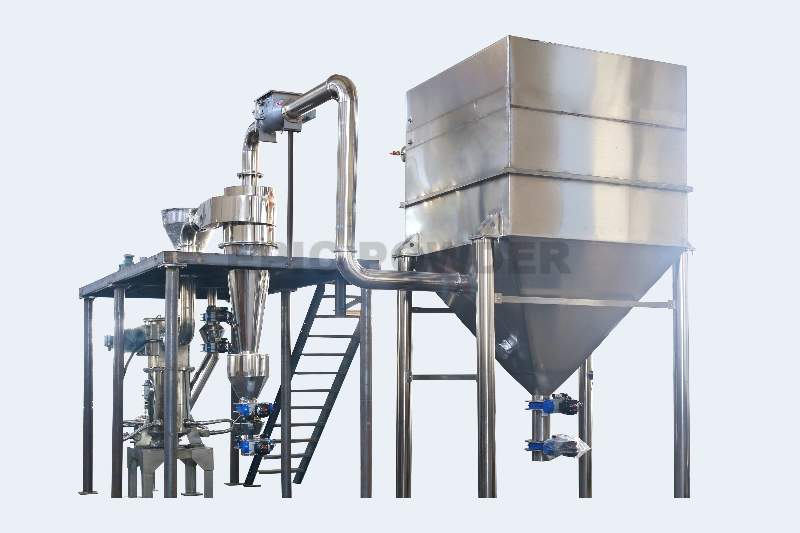
Mechanism for Precise Particle Size Control at 8-12 Microns
The 8-12 μm particle size range (typically referring to D50 median particle size, with D97 <20 μm) is not arbitrary; it is an optimized value that balances solubility, flowability, and bioactivity retention. Particles that are too fine (<5 μm) tend to agglomerate and absorb moisture; those that are too coarse (>20 μm) have lower absorption rates. The jet mill achieves this precision through synergistic regulation of multiple parameters:
- Nozzle Pressure and Gas Flow Rate: Higher pressure (optimal 0.8-1.0 MPa) results in faster airflow velocity and greater collision energy, leading to smaller particle sizes. Experiments show that every 0.1 MPa increase can reduce D50 by 2-3 μm. However, excessively high pressure increases energy consumption and equipment wear. Gas flow rate (typically 200-800 m³/h) directly affects particle concentration and collision frequency and must match the feed rate.
- سرعة عجلة المصنف: This is the most critical parameter for particle size control. Classifier wheel speed (adjustable from 2000-6000 rpm) determines centrifugal force: higher speeds allow finer particles to pass while retaining coarser ones. For the fibrous nature of Rooibos tea, optimizing speed narrows the particle size distribution to ±3 μm (high PSD uniformity).
- Feed Rate and Material Characteristics: Excessive feed rate leads to high particle concentration and insufficient collisions, resulting in larger particle sizes; too slow reduces efficiency. The density (about 0.4-0.6 g/cm³) and moisture (<4%) of Rooibos coarse powder must be strictly controlled. Adding a small amount of anti-caking agent during pretreatment can improve flowability.
- Auxiliary Parameters: Grinding chamber pressure, real-time temperature monitoring (<40°C), and cycle times. Modern intelligent jet mills are equipped with PLC and sensors for automated closed-loop control, ensuring batch-to-batch particle size deviation <5%.
Laser particle size analyzers (such as Malvern or Sympatec) provide real-time monitoring of D10, D50, and D90 to maintain stability within 8-12 μm. In one Rooibos superfine powder project, D50 reached 10.2 μm and D97 16.8 μm, meeting high-end functional food requirements.
Scientific Mechanisms for Bioactivity Retention
Bioactivity retention is the greatest advantage of jet milling for Rooibos tea superfine pulverization. Traditional processes easily destroy heat-sensitive components such as aspalathin (the core antioxidant) and quercetin, whereas jet milling enables “cold grinding”:
- Adiabatic Expansion Cooling Effect: When compressed air expands through the nozzles, temperature drops sharply (Joule-Thomson effect), keeping the overall grinding chamber temperature between -10°C and 35°C—well below the degradation threshold of bioactive components (>50°C). Instantaneous pulverization (<1 second per particle) avoids prolonged heat exposure.
- Optional Inert Environment: Using nitrogen instead of air isolates oxygen and prevents polyphenol oxidation. Studies show that antioxidant activity retention after jet milling exceeds 95%, compared to only 70%-80% with mechanical milling.
- Absence of Shear Heat and Low Contamination: Pure airflow action generates no mechanical friction heat and no metal ions that catalyze oxidation. After cell wall disruption, bioactive components are exposed but not destroyed, significantly improving dissolution rates (HPLC tests show flavonoid dissolution rates increase by over 40%).
- Low-Temperature Supersonic Process Optimization: Some advanced equipment integrates low-temperature modules (0 to -45°C) for further protection of enzymatic active substances.
Comparative literature on traditional Chinese medicine superfine pulverization shows that low-temperature jet milling can achieve activity retention rates of 98% or higher for heat-sensitive herbs such as licorice and Macleaya cordata. The principle is consistent for Rooibos tea as a similar herbal material. The increased specific surface area of the superfine powder also enhances contact with intestinal mucosa, improving bioavailability.
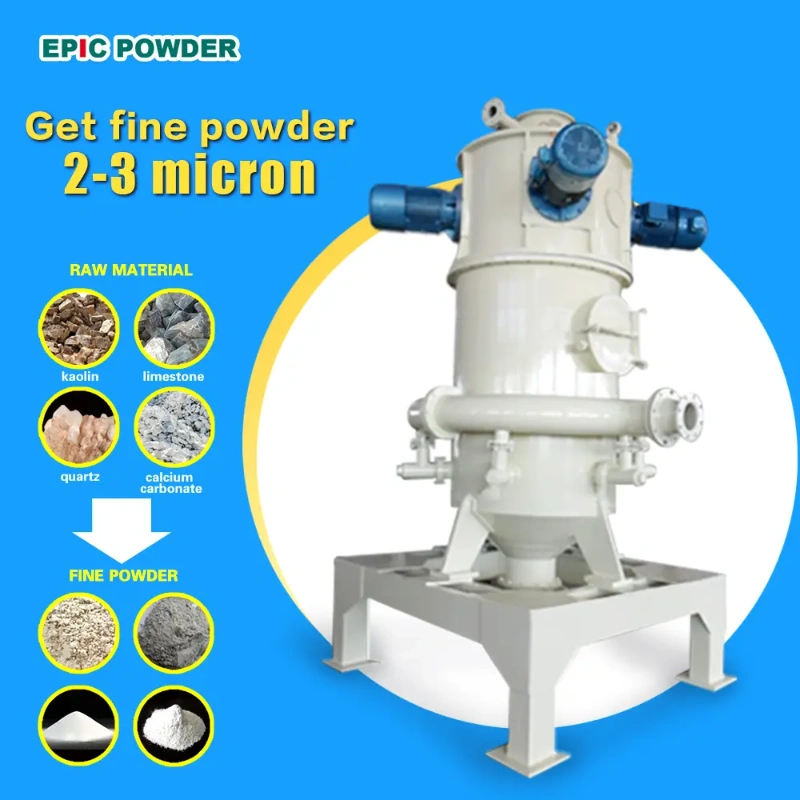
Complete Process Flow and Quality Control
A typical Rooibos tea superfine pulverization process flow includes:
- Raw Material Acceptance: Import high-quality fermented or green Rooibos tea with intact leaves and stems, free from mold.
- Pretreatment: Cleaning, cutting into segments, low-temperature vacuum drying (<40°C, moisture <5%), and coarse crushing (40-80 mesh).
- Jet Mill Superfine Pulverization: Parameter optimization (pressure 0.9 MPa, classifier speed 4500 rpm, feed rate 50-100 kg/h) targeting 8-12 μm.
- Post-Processing: Cyclone collection, microwave or UV sterilization (no المواد الكيميائية residues), and vacuum packaging (moisture-proof and oxidation-proof).
- Testing: Particle size (laser method), moisture (Karl Fischer), bioactive content (HPLC: aspalathin >2%), microorganisms, and heavy metals.
The finished powder is amber-brown-red in color, with good flowability and no off-odor. It can be directly dissolved for drinking or used in formulations. Some companies have achieved commercial production at 1500-2000 mesh (approximately 8-10 μm) for premium products.
Advantages, Applications, and Prospects
Compared to vibration mills, ball mills, or high-pressure homogenizers, jet mills offer advantages such as lower energy consumption (30% lower unit product electricity use), no cross-contamination, and continuous production. In practical applications, Rooibos tea superfine powder has been widely used in:
- Functional foods: Meal replacement powders and solid beverages, improving taste and efficacy.
- Health supplements: Capsules and tablets with higher bioavailability.
- Beauty and skincare: Masks and essences, where micron-sized powder provides strong penetration.
- Infant and pregnant women’s beverages: Mild and non-irritating.
Internationally, Rooibos superfine powder projects have verified this efficiency. Jet milling successfully produces D97 < 17 μm powder. At the same time, it preserves color, flavor, and bioactivity. In the future, the industry will adopt nano-composite technology and AI parameter optimization. This process will further promote the upgrading of the Rooibos tea industry. It will help the “national treasure tea” reach the global health market.
خاتمة
In the processing of Rooibos tea, the jet mill relies on three core elements. These are particle collision, low-temperature cooling, and precise classification. They accurately control particle size at 8-12 microns. Simultaneously, they maximize the retention of bioactive components such as aspalathin. This technology is an innovation in equipment. It is also a model for the efficient utilization of herbal resources. Scientific parameter control and strict quality management deliver higher-bioavailability health products to consumers. This provides sustainable competitiveness for related enterprises. In the future, more clinical validation and process iterations will occur. The “superfine charm” of Rooibos tea will surely shine even brighter.

شكرًا لقراءتكم. آمل أن يكون مقالي مفيدًا. يُرجى ترك تعليق أدناه. يمكنكم أيضًا التواصل مع ممثل خدمة عملاء زيلدا عبر الإنترنت لأي استفسارات أخرى.
— نشر بواسطة إميلي تشين